


The licensing model: scaling without growing
One of the most established models in research environments is the licensing of intellectual property. The logic is simple: the developer retains ownership of the technology and grants third parties the right to exploit it in exchange for royalties or payments.
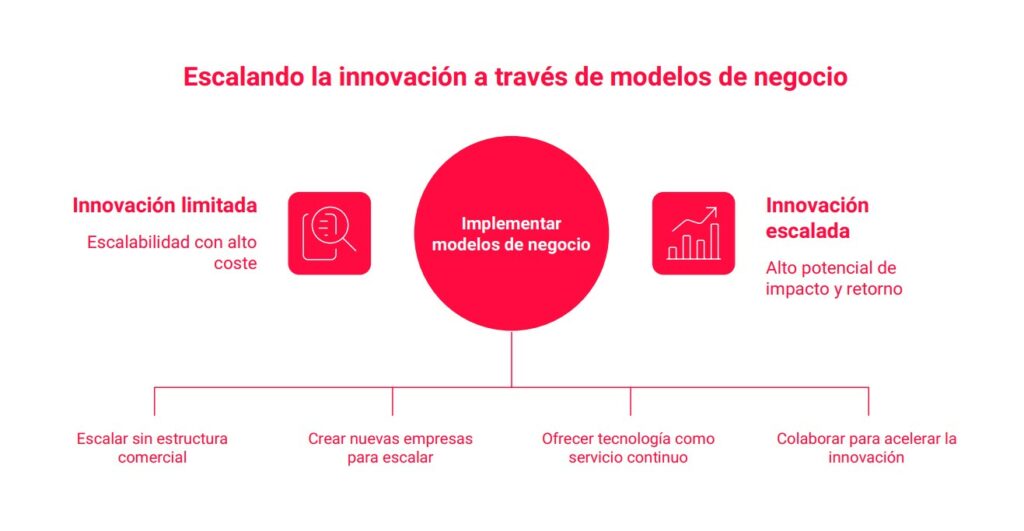
This model remains especially relevant in universities, technology centers, and sectors such as biotechnology, where knowledge protection is critical. Its great advantage is scalability with low operating costs: there is no need to build an in-house commercial or industrial structure.
However, it also has a limitation: there is less control over how the technology is applied, and market learning remains in the hands of third parties.
The key here is not just to license, but to license strategically, choosing partners that not only pay, but also help develop the market.
Spin-offs and startups: when technology becomes a company
When the goal is to capture more value—not just transfer it—the spin-off model emerges. Here, the technology is not licensed, but instead becomes the core of a new company.
This approach allows:
- attracting investment (especially venture capital),
- building a complete value proposition,
- and controlling product development and its positioning in the market.
But it also means taking on a higher level of uncertainty. It is not enough to have a good technology: you also have to build a team, a market, a revenue model, and a growth strategy.
It is a high-risk model, but also one with high potential for impact and return.
In Compass terms, it is the move from “transferring knowledge” to creating an organization capable of scaling it.
XaaS: when R&D&I becomes a continuous service
Digitalization has introduced a profound shift in how innovation is monetized: the move from product to service. Under the XaaS (Everything as a Service) paradigm, technology is no longer sold as a one-off offering but instead provided as a continuous solution.
This is clearly seen in:
- SaaS (software de IA o analítica de datos),
- PaaS (industrial equipment sold based on performance),
- DaaS (datos generados por procesos de I+D convertidos en insights para terceros).
The main advantage is twofold:
- recurring revenue,
- and continuous learning thanks to the customer’s real-world use.
This transforms R&D itself: it stops being a closed process and becomes a continuous improvement cycle based on feedback.
In this model, the customer does not appear at the end of the process: they are part of it from the beginning.
Open innovation: creating value with others
Another major shift in R&D&I models is the consolidation of open innovation. Companies no longer innovate alone, but rather in collaboration with startups, universities, suppliers, and even competitors.
This is where models emerge such as:
- multisided platforms,
- open source,
- freemium models,
- or co-creation programs with customers.
The goal is not only to develop technology faster, but also to reduce time-to-market and increase the likelihood of adoption.
In this context, value lies not only in what is developed, but also in how the ecosystem that makes it possible is built.
Innovation ceases to be an internal activity and becomes a relational capability.
Circular economy: when sustainability becomes a business model
At the same time, a fifth model is emerging strongly—one that is less a structure than a design logic: the circular economy applied to R&D&I.
More and more innovative projects are being designed to:
- reuse materials,
- optimize resources,
- reduce emissions,
- or generate a positive environmental impact.
This no longer responds only to regulatory criteria, but also to real business opportunities. Sustainability becomes a source of revenue, not just a cost or an obligation.
Innovating today also means designing solutions that operate within a more efficient, more resilient, and more responsible system.
So, which model should you choose?
There is no single model. The choice depends on several factors:
- the level of technological maturity (TRL),
- the type of market,
- the team’s capabilities,
- and the strategic objective (revenue, impact, scalability, control, etc.).
But there is one idea that runs through all of these models:
innovation begins with the customer, not with the technology.
Many R&D&I projects fail not because the technology does not work, but because no one has clearly defined who needs it, how they are going to use it, and why they are going to pay for it.
A final reflection
In a context where technology is advancing faster and faster, the real differentiator no longer lies in discovering something new, but in knowing how to bring it to market in a sustainable and scalable way.
Business models in R&D&I are evolving toward more open, more connected, and more real-use-oriented frameworks. And that requires a shift in mindset: moving away from thinking in terms of isolated technological development and starting to design systems in which knowledge flows, is validated, and is transformed into value.
Because, in the end, innovation is not about inventing.
It is about making something work… outside the laboratory.